
10000 Da Vincis
We need AI to create more artists, not more art

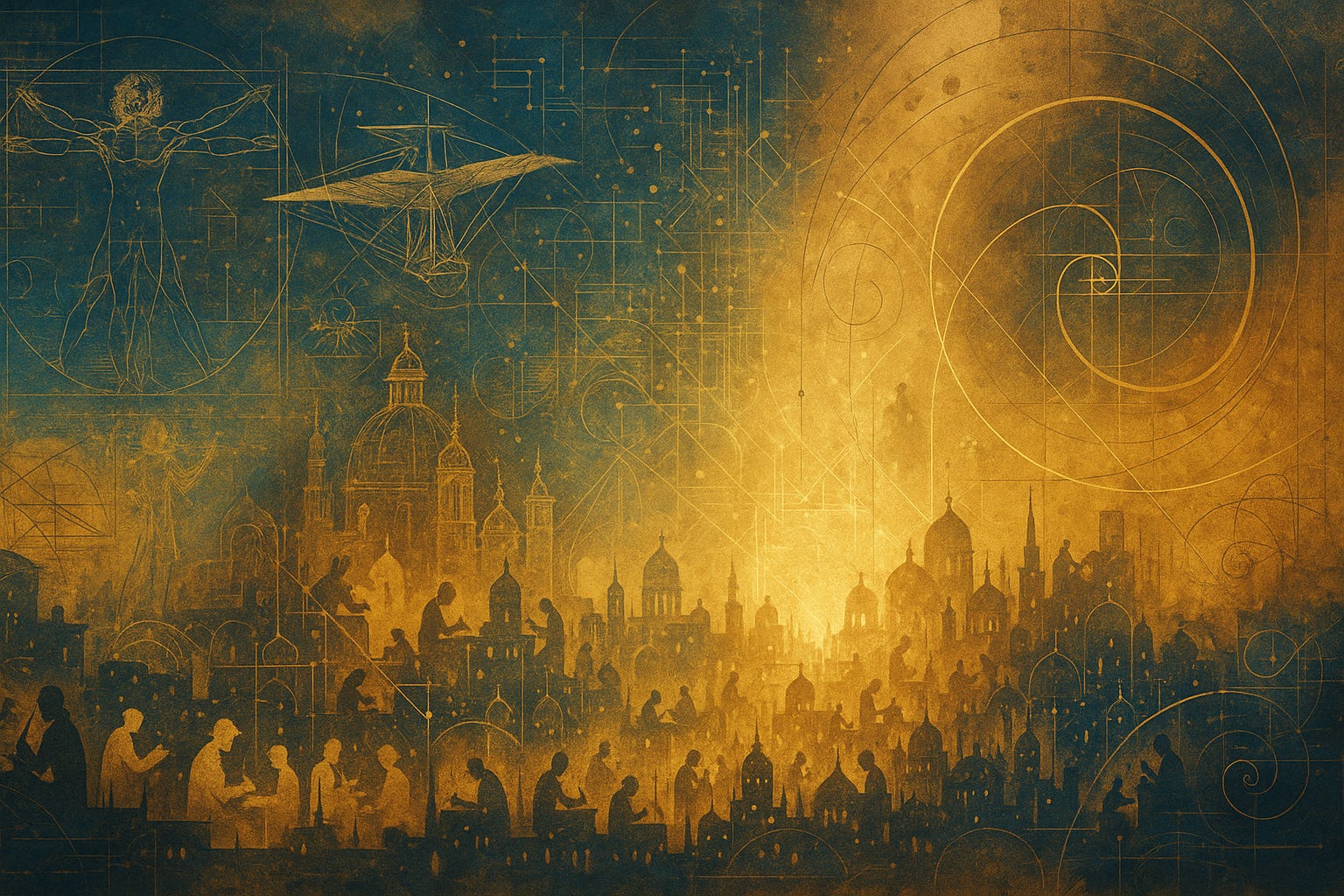
For five hundred years, the name Leonardo da Vinci has represented the absolute summit of human potential. He was not merely a painter of genius, but a master of anatomy, an engineer of war machines, an architect, a musician, a botanist. His mind was a bridge across every known discipline. His notebooks, filled with as many failures and dead ends as triumphs, are a testament to a life defined by relentless, curiosity-driven struggle. He is the archetype of the singular talent, the unrepeatable polymath.
The stated ambition of our current technological wave is to give everyone a polymath in their pocket. With a line of text, we can summon photorealistic images, generate sonatas in the style of Bach, and produce architectural renderings in seconds.
This is a seductive promise. But we may have fallen in love with the finished painting and forgotten the value of a lifetime spent learning how to mix the paints.
When the camera was invented, portrait painters faced an existential crisis. A machine could now capture a perfect likeness in minutes. Freed from the burden of perfect representation, painters like Monet and Picasso were forced to ask a deeper question: what can a painting do that a photograph cannot? The answer was to capture impression, emotion, perspective. Photography killed portraiture as a craft of mimesis, and in doing so, gave birth to modern art.
We are now at a similar inflection point, but for nearly every domain of human skill at once. The great danger is not that AI will render human creativity obsolete, but that it will devalue the very process that makes it meaningful. The 10,000-hour rule is not just about becoming proficient. That struggle is a crucible that forges discipline, resilience, and a unique point of view. An artist who spends a decade learning the subtleties of light acquires not just a skill, but a way of seeing the world.
And yet, this focus on the struggle of the individual artist misses a larger, more tragic struggle: the struggle of genius against circumstance.
How many da Vincis were lost to the plow, their minds wired for mechanics and anatomy but their hands calloused by a lifetime of subsistence farming? How many Curies were lost to the kitchen, their brilliant insights silenced by a world that refused them a lab?
We comfort ourselves with the myth of the singular genius, but this is a convenient fiction. It absolves us of responsibility for the countless potential geniuses lost to history. A more rigorous model is that genius is not a rare mutation, but a seed that falls on a vast and mostly barren field. For most of human history, the soil of opportunity—access to knowledge, tools, and time—has been so thin that only the luckiest seeds have had any chance to grow.
The overwhelming majority of human intellectual potential has likely been squandered not by a lack of innate ability, but by overwhelmingly high activation energy. This is the total cost of entry into deep, creative work. We can define this total energy (E_total) as the sum of two distinct costs:
E_total = E_disciplinary + E_existential
E_existential is the relentless, grinding cost of staying alive. It is the time and cognitive overhead consumed by the work required to earn a living, the management of household logistics, and the low-grade anxiety of non-creative problem-solving. It is the genius of a potential physicist being drained away by a 12-hour shift or a leaky faucet.
E_disciplinary is the friction of the academy and the profession. It is the years spent mastering foundational knowledge and the high cognitive load of learning a new professional syntax. To be a da Vinci required a patron, the Medici, to grant the freedom to explore anatomy one day and engineering the next. For everyone else, our educational and economic systems have demanded specialization.
The true promise of AI is not the automation of creativity, but the systematic dismantling of these barriers. It is a tool to launch a systemic assault on both forms of friction simultaneously.
The power of an AI is its ability to act as a universal interface to specialized knowledge. Consider its role in collapsing disciplinary friction:
The Universal Analogy Generator: A core barrier between fields is language. An AI can function as a real-time translator of concepts. A user can prompt: "Explain mutual information from information theory using an analogy from protein interaction networks." This bridging of semantic gaps lowers the cognitive load of entry into a new field.
Conceptual Scaffolding: A historian with a hypothesis about trade routes need not spend months mastering Python to perform a network analysis. An AI can serve as an interactive partner, translating the historian’s natural-language goal into functional code. It offloads the procedural minutiae, freeing human cognition for higher-level insight.
Zero-Consequence Simulators: True understanding requires experimentation. An AI can create high-fidelity sandboxes for thought, allowing an amateur urbanist to simulate the second-order effects of a new zoning law. This enables the rapid, iterative learning that psychologist Anders Ericsson called "deliberate practice."
Simultaneously, AI can attack the friction of existence. A personalized agent can become a cognitive exoskeleton for life itself. By managing schedules, automating finances, and navigating bureaucracy, it absorbs the cognitive load of the non-essential. This is not about saving a few hours; it is about reclaiming the vast, contiguous blocks of deep focus that high-level work demands.
When the cost of exploring a new domain drops to near zero, the person with a restless, cross-disciplinary intellect is suddenly unshackled. The biologist who wonders about fluid dynamics in star nebulae can now model it. The historian who sees network theory in the fall of Rome can now test it. We are entering an era where the most valuable individuals may not be the deep specialists, but the radical connectors who can stand astride multiple domains and ask the questions others cannot see.
This dual reduction in friction brings us to the precipice of a phase transition. What happens to the world when E_total drops for a critical mass of the population?
The foreseeable result is a Cambrian explosion of problem-solving. Today's wicked problems are intractable because they are too complex for any single discipline. Their solutions live in the uncharted territory between them. Picture a small, distributed team attacking climate change: A biologist in Brazil designs a carbon-capturing microorganism. A materials scientist in Germany designs its optimal photoreactive enzymes. An economist in Kenya models the incentives for its deployment. Their common language is the AI interface that translates their distinct expertise into a shared, actionable model. This is not a team of specialists. It is a single, temporary polymathic entity.
This world is not without formidable dangers. A Cambrian explosion produces monsters as well as miracles. A world where individuals are this highly leveraged is one where a single, resonant bad idea can do immense damage. The intellectual chaos could make consensus-building impossible.
But the alternative is to accept the status quo: a world that systematically squanders its greatest resource. We have built systems that force potential Da Vincis to spend their lives as accountants, patent clerks, or staff software engineers. We now have the tools to offer them a different path.
We are building a machine to unburden the human mind, and we have no idea what that mind is capable of when it is finally free.
References: